If you run or manage an office-based business, providing suitable first aid in the office is part of your responsibility for employee safety. However, that does not mean every office needs the same number of first aiders or the same type of qualification.
What Are The Legal Office First Aid Requirements?
Under the Health and Safety (First-Aid) Regulations 1981, employers are responsible for ensuring employees can receive immediate attention if they are injured or become ill at work.
The important phrase in HSE guidance is that provisions must be “adequate and appropriate in the circumstances”. There is no single training package that automatically makes every office compliant.
Your arrangements may need to include:
- A suitably stocked first aid kit
- Someone responsible for first aid arrangements
- Appropriately trained first aiders where your assessment identifies a need
- Suitable arrangements during holidays, sickness and other absences
- Clear information so employees know who to contact
- Additional provision for particular workplace risks
An appointed person takes responsibility for arrangements such as maintaining equipment and contacting the emergency services when required. Formal training is not required simply to perform that appointed-person role.
Does Every Office Need A Qualified First Aider?
Not necessarily.
HSE states that some small, low-risk workplaces may only require a medical box and an appointed person to take responsibility for arrangements.
However, employers should not assume that an office is automatically low risk simply because people work at desks.
The decision should come from your needs assessment.
Current HSE guidance suggests that for low-hazard workplaces such as offices, shops and libraries:
- Fewer than 25 employees may require at least one appointed person.
- Between 25 and 50 employees may require at least one person trained.
- More than 50 employees may require at least one First Aid at Work trained person r for every 100 employees, or part thereof.
These figures are guidance rather than a substitute for assessing the actual circumstances of the business.
Your own risks, workforce and operating arrangements may justify greater provision.
What Should An Office Assessment Include?
An assessment is the starting point for deciding what training and equipment your business actually requires.
HSE advises employers to consider the workplace, workforce and hazards present.
For an office, useful questions include:
- How many people normally work from the premises?
- Do employees work different shifts?
- Are staff regularly working alone?
- Do people regularly travel for work?
- Are employees working remotely or from co-working spaces?
- Do customers, contractors or members of the public visit?
- Are there multiple floors or separate areas?
- How close is the workplace to emergency medical assistance?
- Have previous accidents or illnesses highlighted particular risks?
- What happens when your usual first aider is on annual leave or off sick?
Your assessment should also consider whether some employees have particular needs that could affect your arrangements.
HSE updated its detailed guidance in 2024 to emphasise consideration of employees’ mental health as part of needs assessments.
Recording your assessment is not generally mandatory, but HSE notes that doing so can provide a useful record of how you reached your decision.
When Might An Office Need First Aid At Work Training Instead?
First Aid at Work provides more comprehensive training than EFAW.
It covers a broader range of injuries, medical emergencies and casualty-management situations.
Essex Medical Training’s Level 3 course includes subjects such as:
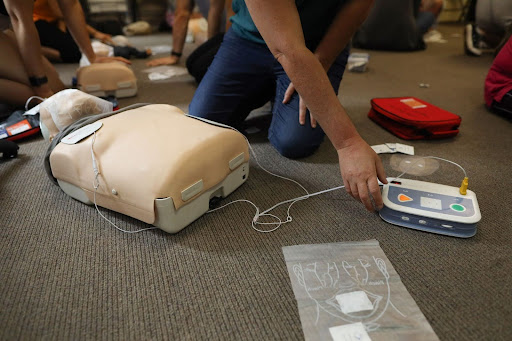
- CPR and AED use
- Wounds and bleeding
- Burns and scalds
- Head, chest and abdominal injuries
- Bone injuries
- Heart attacks
- Stroke
- Asthma
- Epilepsy
- Diabetes
- Allergic reactions
The course is delivered over three days according to the company’s existing course information.
An office might identify a need for this more extensive qualification because of workforce size, specific hazards, previous incidents or other circumstances identified through its assessment.
The key point is not to choose a course simply because it sounds more comprehensive.
Choose the qualification that matches your assessed needs.
Compare Our Level 3 Work Course
What Risks Can Still Exist In An Office?
Office environments are normally considered lower hazard than construction sites, factories or warehouses, but that does not mean emergencies cannot happen.
Common situations a first aider may need to respond to include:
- Someone becoming unresponsive
- Cardiac arrest
- Choking while eating
- Falls
- Cuts
- Burns from hot drinks
- Sudden illness
- Seizures
- Asthma attacks
- Allergic reactions
How Many Office First Aiders Should You Train?
There is no universal legally prescribed number that applies to every business.
Your answer should be based on your needs assessment.
Beyond overall headcount, consider whether enough trained people will actually be available whenever employees are working.
For example, having one trained first aider may look adequate on paper, but not if that person:
- Works part-time
- Regularly works from home
- Travels frequently
- Takes annual leave
- Covers a different floor
- Works different hours from other employees
HSE specifically advises employers to consider staff work patterns, holidays, absences, lone workers and how the workforce is distributed.
For hybrid offices, this deserves particular attention.
Your office may contain 40 employees on one day and 15 the next. Your arrangements should work under your real operating pattern, not simply your total payroll number.
What Should Be Inside An Office First Aid Kit?
There is no mandatory universal contents list that suits every workplace.
Your kit should reflect the findings of your needs assessment.
For a straightforward office, this will usually mean supplies for common minor workplace injuries, but organisations with additional hazards may need further equipment.
The person responsible for arrangements should also ensure the kit remains stocked and accessible.
Do not allow a first aid kit to become something that is installed once and then forgotten.
Create a regular check covering:
- Expiry dates
- Used items
- Damaged packaging
- Accessibility
- Signage
- Location
- Responsibility for replenishment
A stocked kit is only one part of your arrangements. It does not replace trained personnel where your assessment says they are necessary.
Frequently Asked Questions
Does A Small Office Need A First Aider?
Not always. HSE guidance indicates that some small, low-risk workplaces may only require an appointed person and appropriate equipment. Your needs assessment should determine your arrangements.
Is Emergency First Aid At Work Enough For An Office?
It can be appropriate for lower-risk workplaces where the needs assessment identifies that level of training as suitable. Larger offices or workplaces with additional risks may require more comprehensive training.
Can One First Aider Cover The Whole Office?
Possibly, but only if that provides adequate cover in practice. Employers need to consider working hours, absence, holidays, hybrid working and the distribution of employees, not simply the number of people who hold certificates.
How Long Does A Certificate Last?
FAW and EFAW certificates used for workplace purposes normally last three years. HSE strongly recommends annual refresher training to help first aiders maintain their skills.
Can Training Be Arranged For A Whole Office Team?
Yes. Essex Medical Training provides training for organisations as well as individual learners, and workplace or group training options can be discussed with the team.
Build A Safer, Better Prepared Office
Good first aid in the office starts with understanding what your workplace actually needs.
For some small, low-risk offices, appropriate arrangements may be relatively straightforward. Larger teams, more complex working patterns or additional hazards can mean trained first aiders and more extensive workplace training are appropriate.
The important thing is to assess rather than assume.
At Essex Medical Training, our courses are delivered by experienced healthcare professionals who bring practical knowledge into the training environment. Whether your assessment identifies the need for Emergency First Aid at Work, comprehensive First Aid at Work training or refresher training, we can help you understand your course options.