
No law requires a UK workplace to have a defibrillator. HSE is clear that health and safety legislation does not require one. Whether your workplace should have one is a different question, and it is answered by your first aid needs assessment. This guide explains how to make that decision, what to do once you have a defibrillator, and how to make sure your staff will use it.
Why The Question Matters
The British Heart Foundation reports that there are more than 30,000 out-of-hospital cardiac arrests in the UK every year and that fewer than one in ten people survive. Every minute that passes without CPR or defibrillation can reduce the chance of survival by up to 10 per cent. Immediate CPR and defibrillation can more than double it.
Those figures explain why the minutes before an ambulance arrives matter so much. A defibrillator on the wall and people willing to use it are what fill that gap. Yet public access defibrillators are used in fewer than one in ten out-of-hospital cardiac arrests, which is as much about confidence as it is about availability.
What The Law Says
The Health and Safety (First-Aid) Regulations 1981 require employers to provide adequate and appropriate equipment, facilities and people so that employees receive immediate attention if they are injured or taken ill at work. What counts as adequate and appropriate is decided by a first aid needs assessment that looks at your workplace, your workforce and your risks.
A defibrillator is not on any mandatory list. If your assessment identifies a need for one, though, you should provide it, and you then need to look after it and make sure people know how to use it.
How To Decide: Six Questions
- How many people are on site? The more staff, visitors and customers pass through, the more likely it is that one of them will have a cardiac arrest there one day.
- Who are they? An older workforce or customer base, or a setting such as a gym, leisure centre or care service, raises the likelihood.
- How far is the nearest defibrillator? Check the British Heart Foundation’s Defib Finder for your postcode. One that is locked inside another building after 5pm, or a five-minute walk away, will not reach a casualty in time.
- How long would an ambulance take? Rural sites, large estates and anywhere that is hard to find or hard to get into need to be more self-sufficient.
- What work do you do? Heavy physical work, work with electricity and lone or remote working all strengthen the case.
- When is the site occupied? Night shifts and weekends are when help from outside is furthest away.
If several of these apply, a defibrillator is a reasonable finding for your assessment to reach. Our free first aid needs assessment calculator will help you set out the rest of your provision alongside it.
If You Decide To Get One
- Put it where it can be reached. Central, unlocked during working hours, clearly signed and known to everyone. If it is outside, it needs a suitable cabinet.
- Register it on The Circuit. The Circuit is the national defibrillator network, run by the British Heart Foundation with the Resuscitation Council UK, St John Ambulance and the Association of Ambulance Chief Executives. Registration lets 999 call handlers direct people to your defibrillator in an emergency.
- Give someone the job of checking it. Electrode pads and batteries have expiry dates. A named person should check the status indicator regularly and keep a simple log.
- Keep a small kit with it. Scissors, a razor, a towel and a face shield save time.
- Tell everyone. Include its location in inductions and on your first aid notices.
Do Staff Need Training To Use A Defibrillator?
A modern automated external defibrillator is designed to be used by anyone. It gives spoken instructions, analyses the heart rhythm itself and will only deliver a shock if one is needed. Nobody should hold back from using one because they have not been trained.
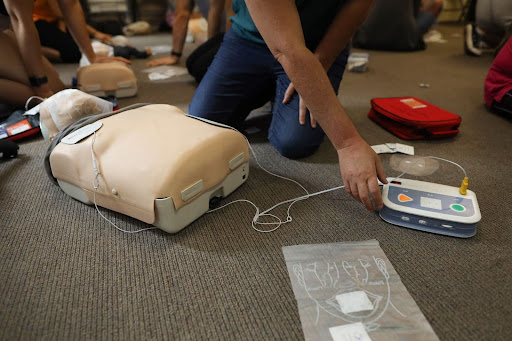
Training still makes a real difference, because it removes the hesitation. People who have opened the case, placed the pads on a manikin and heard the prompts act faster when it is real. Defibrillator use is an integral part of both the First Aid at Work and Emergency First Aid at Work courses, so every workplace first aider we train practises CPR and defibrillation together on training units, to current Resuscitation Council UK guidelines.
For schools and nurseries, using a defibrillator on a child is covered on our paediatric first aid course in Essex. For healthcare settings, our BLS and ILS courses go further, with the Immediate Life Support qualification for clinicians who lead the response.
What About Workplaces Without One?
If your assessment concludes that you do not need your own defibrillator, write down why, and make sure your first aiders know where the nearest public one is and how to get into it. Review the decision when anything changes: more staff, a new site, different working hours or a different customer base.
Frequently Asked Questions
Is a defibrillator a legal requirement in the workplace?
No. HSE states that health and safety legislation does not require an employer to have a defibrillator. If your first aid needs assessment identifies a need for one, you should provide it.
Can someone be sued for using a defibrillator?
The Resuscitation Council UK addresses this in its guidance CPR, AEDs and the law. It says there have been no reported cases of someone successfully suing a person who came to help them in an emergency, and that the risk of being held liable for attempting to resuscitate someone in cardiac arrest is extremely small, because without help the person will die. A defibrillator will also not deliver a shock to someone who does not need one. This is general information and not legal advice.
Is defibrillator training included in a first aid course?
Yes. It is part of the syllabus for both First Aid at Work and Emergency First Aid at Work.
How do I register a workplace defibrillator?
Register it on The Circuit, the national defibrillator network, so that ambulance services know where it is and can direct people to it.
Train Your Team
Essex Medical Training delivers first aid training in Essex, Southend-on-Sea and Thurrock, at our Battlesbridge training centre or at your premises. Our trainers are healthcare professionals with frontline emergency ambulance and emergency department experience, who have used defibrillators on real patients. See our first aid courses, or call 0800 820 3692 to talk it through.